

You want to hold a cacao ceremony, but don't know how?
You’ve heard the term before. Maybe from a friend, maybe at a yoga retreat, maybe just while scrolling online. Cacao ceremony. Sounds nice. But it also sounds like: candles, chanting, people sitting cross-legged saying things you aren't sure you can or want to join in on.
And then you ask yourself the real question: isn't that just... hot chocolate by candlelight?
Not quite. And that is exactly where the wonderful difference lies, which we would like to highlight for you in this article.
A cacao ceremony is no hocus-pocus
Let's share this right at the beginning, because this thought keeps most people from even starting: a cacao ceremony is not a religious confession or an esoteric program you have to follow. It is a conscious ritual – nothing more, but also nothing less.
At its core, a ritual is a recurring action to which you give special meaning. You probably do this already without calling it that: the first coffee in peace in the morning, the walk after work to clear your head. A cacao ceremony works on the same principle – just more consciously, and with a drink that has been used for this very purpose for thousands of years: by the Maya and Inca as a connection between human, body, and that one sustainable moment.
You don't need a group, a guide, or anything to smudge with. You need a quiet quarter of an hour, your favorite mug, and the right cacao of your choice.
The guide: How to create your cacao ceremony at home
This is the part you are probably here for. A few steps, no prior knowledge necessary:
1. Create space and time
A quiet place is enough. No phone, no distractions. Whether in the morning at sunrise or in the evening to wind down the day – more important than the time is that you take it consciously.
2. Choose the right cacao
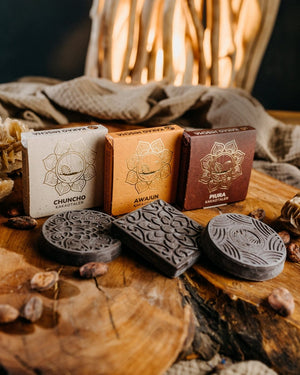
Choose a ceremonial cacao that speaks to you. We recommend one of our single-origin cacaos like Chuncho, Piura, or Awajun.
These cacaos are organically certified, sourced responsibly, and produced within our unique appreciation chain, from cultivation to the cup. This care is reflected not only in the quality but also in their particularly fine and unmistakable taste.
2. Have the right cacao on hand
Select your ceremonial cacao of choice. We recommend our single-origin cacao like “Chuncho,” “Piura,” or “Awajun.” This is organically certified, responsibly sourced, and has a unique appreciation chain that is particularly noticeable in its great taste.
👉 Discover the starter set from Kakao Mischa now!
3. Warm up water or plant-based drink – do not boil
Heat water or a plant-based milk of your choice (oat or almond works well because it is mild in taste) on the stove. Important: do not boil. From about 42°C, valuable ingredients in the cacao begin to break down – gentle heating is completely sufficient.
4. Weigh the cacao
For a noticeable but everyday effect, 15–25g of pure, ceremonial cacao per cup has proven to be effective. If you want a more noticeably (we say ritual) dose, feel free to use 30g of cacao. Ease yourself into the lower amount the first time and increase it from ceremony to ceremony.
5. Froth and stir
Then add the cacao to the warm liquid and stir it thoroughly until it has completely dissolved – this works particularly well with a whisk or milk frother. This minute of stirring is already part of the ritual: slowly, with attention instead of as an afterthought.
6. Pause for a moment and set an intention
Before you drink, take a moment to breathe. A question can help: What do I want to let go of today? What am I really grateful for right now? There is no right or wrong here – just your moment.
That’s all. No two hours, no course, no preparation over several days. A conscious cup of cacao, prepared properly.
Click here for the step-by-step guide with Mischa:
Why is it still not "just hot chocolate"?
This is the point where many guides on the net stop and where the real answer only just begins: whether your ceremony becomes what you hope for does not depend on the steps above. It depends on the cacao itself.
Most of what is called "cacao" in the supermarket has little to do with ceremonial, real cacao. Baking cocoa is usually heavily de-oiled (the valuable cocoa butter has been removed), often alkalized (a process that industrially equalizes color and taste while destroying aromas and secondary plant compounds), and usually comes from blends of highly varied origins and harvest qualities.
Nobody has told you that until now – probably because it’s not on any packaging in the drugstore. It is not your fault. It is simply a different category of goods under the same name.

So how does ceremonial cacao differ significantly from conventional cocoa?
Single-origin instead of industrially blended
Every cup comes from just one type of cacao. This ensures an unadulterated, characteristic aroma with fine taste nuances, similar to high-quality coffee or wine.
Gently processed at low temperatures
Due to the particularly gentle processing, many of the natural plant compounds, antioxidants, and aromas are preserved. This allows the cacao to unfold its full flavor profile and its natural properties. Ceremonial cacao also contains magnesium, iron, and potassium – components that naturally occur in high-quality cacao.
With natural cocoa butter
The valuable cocoa butter is preserved entirely. It gives the cacao a velvety-creamy consistency, carries the fine aromas, and ensures a particularly full-bodied taste experience, completely without additives.
How do you find the right cacao for your ceremony?
Not every cacao is equally suitable for a cacao ceremony. Origin, cacao variety, and gentle processing shape taste and quality.
In our Kakao Mischa shop, you will find exclusively single-origin, organically certified, and responsibly sourced cacaos from direct cooperation with our local cooperatives. The Chuncho is considered one of the oldest known original cacao varieties in the world and has been cultivated for generations in the Peruvian Río Urubamba Valley. The range is complemented by the powerful Piura and Awajun varieties, as well as limited specialties like Esmeraldas, Arhuaco, and Jolomijix.
This way, you will find a cacao whose origin, quality, and character will accompany your moment of enjoyment in a special way.
A ceremony is only as good as the cacao in it
You now know the steps. You know what matters when it comes to cacao. The last building block: having the right cacao for it without having to test ten varieties yourself.
Our cacao starter set contains exactly what you need for your first ceremonies: the best samples of single-origin ceremonial cacao, gently processed, directly from South America – plus a short preparation guide to get you started.